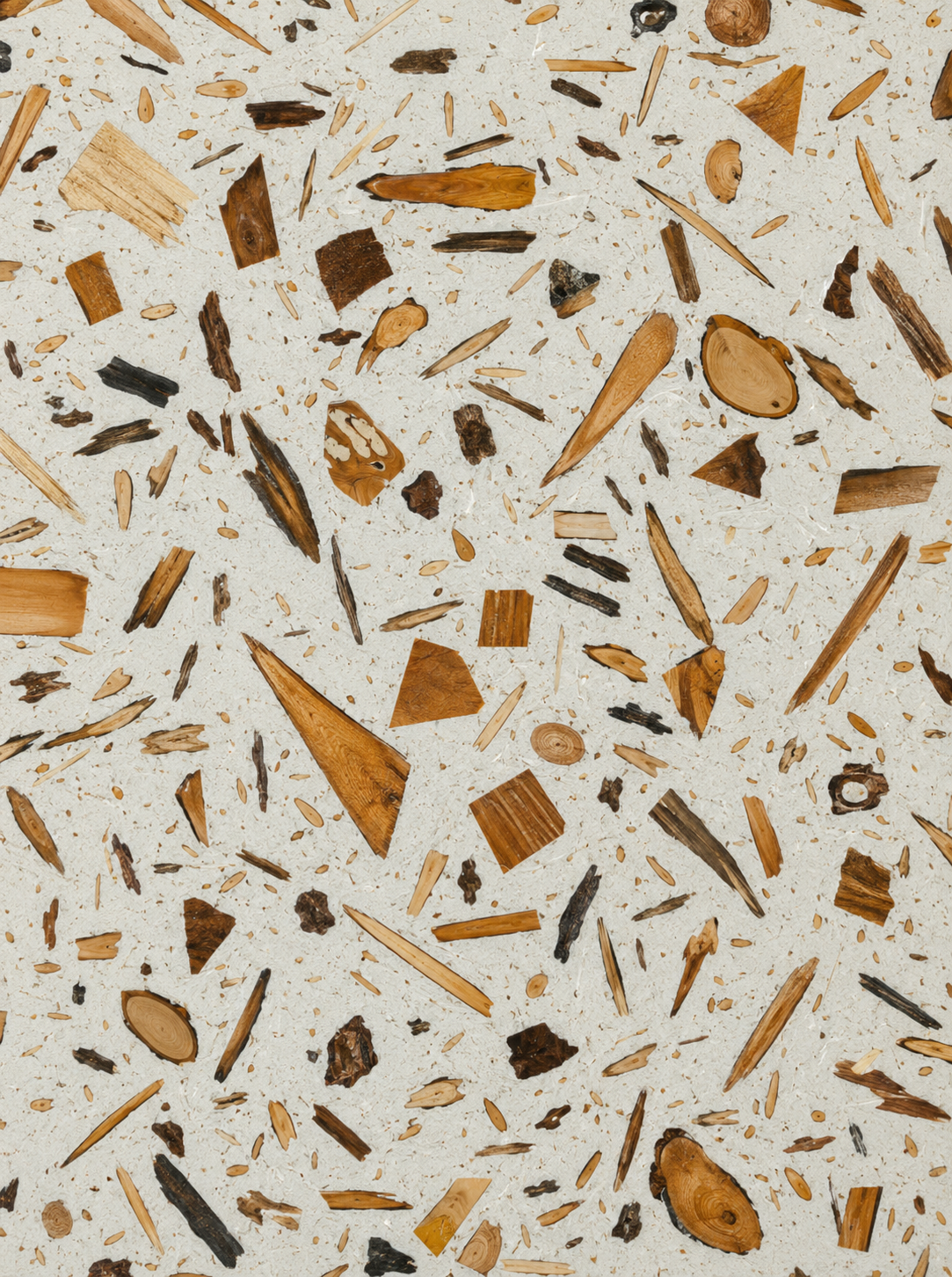
Every piece of timber terrazzo we make starts as something another workshop would throw away. Here is how an offcut becomes a table top, a counter or a wall tile in our Riga studio.
1. Collecting the timber
We work with reclaimed timber offcuts: the ends, slices and scraps left over from woodworking. Different woods bring different colours and grain, from pale tones to dark heartwood, and that variety is what gives the finished surface its depth.
2. Cutting the pieces
The offcuts are cut into three kinds of shape: round cross-sections that show the growth rings, long grain slices, and irregular fragments. The mix of shapes and sizes decides the character of the finished surface.
3. Setting by hand
Before anything is cast, the timber is placed by hand into the mould. This is where the design happens: a few large rounds for a calm, open surface, or a dense field of small fragments for a busier one. We agree the density and layout with the client first.

4. Casting the base
The mineral composite base is poured around the timber in the chosen colour: soft grey, warm white, or a bolder tone like cobalt blue. It locks every piece of wood in place.

5. Finishing
Once the base has cured, the surface is finished smooth, so wood and base sit flush in one plane and every cross-section shows clearly.

6. Sample first, then production
For every project we make a physical sample first, so colour, timber density and finish are approved before full production begins. Because every offcut is different, no two finished pieces are ever the same.
Where it ends up
Side tables and table tops, retail display plinths and counters, wall tiles and feature walls. It is made for surfaces you see and touch, not for floors.


See the colours, finishes and applications on our timber terrazzo page, or get in touch to start a project.